
The new Altaviva™ device is implanted near the ankle, designed to regulate bladder control by restoring communication between the bladder and the brain
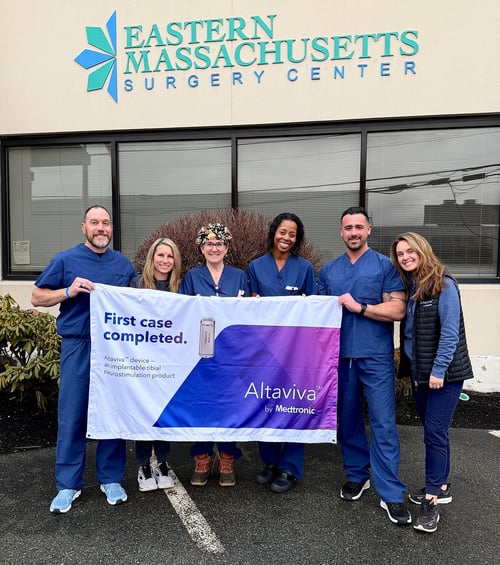
Dedham, MA, Jan. 8, 2026 – Greater Boston Urology (GBU) today announced that it has implanted the first Altaviva™ device, a new treatment option to manage bladder control symptoms, in Norwood, MA. The device, which is implanted near the ankle above the tibial nerve, is approved by the U.S. Food and Drug Administration (FDA) to treat urge urinary incontinence (UUI).
Over 16 million adults in the United States experience UUI,1,2 a symptom of overactive bladder (OAB) that is characterized by a sudden, intense urge to urinate, often followed by involuntary leaks before reaching the bathroom.3 The Altaviva device, developed by Medtronic, offers a minimally invasive4 treatment option with several key benefits:
- No sedation or radiation is required for the procedure5
- Same-day therapy activation6
- MRI compatibility from day one7
- The device battery lasts up to15 years*,6
The inaugural procedure was performed by Dr. Angel Marie Johnson, who stated, “Today’s Altaviva procedure was efficient, precise, and painless. I look forward to offering this amazing new treatment to my overactive bladder patients.”
The leadless Altaviva™ device is approximately half the length of a stick of chewing gum. It is implanted near the ankle and sends electrical pulses to the tibial nerve to help restore the communication pathway between the bladder and brain.8,9 Recharging is needed once or twice a year under standard settings and will take up to 30 minutes for the device to go from zero to 100% charged, 10 eliminating the need for daily at-home charging equipment. This treatment, called tibial neuromodulation, is a proven therapy for reducing bladder control symptoms.11-16
GBU is committed to providing cutting-edge treatments to its patients. If you or someone you know is experiencing bladder control symptoms, schedule appointment to see if you are a candidate for the Altaviva device.
About Greater Boston Urology
Founded in 2010, Greater Boston Urology is an integrated urology practice. This medical model allows the practice to pool resources, resulting in more—and better—options for patients. From the moment a patient walks through the door, GBU strives to manage each patient's care in-house. This in-house care includes imaging studies, diagnostic testing, pathologic testing, and surgical treatments. Supported by a talented team of urologists, urogynecologists, nurse practitioners, and physician assistants, GBU has multiple Care Centers in Greater Boston, the South Shore, and the Cape & Islands. To learn more or schedule an appointment, visit www.GreaterBostonUrology.com.
References:
* Based on clinical and bench testing for expected therapy settings
- Stewart WF, Van Rooyen JB, Cundiff GW, et al. Prevalence and burden of overactive bladder in the United States. World J Urol. 2003;20(6):327-336.
- US Census Bureau 2020. US adult and under-age-18 populations: 2020 census. https://www.census.gov/library/visualizations/interactive/adult-and-under-the-age-of-18-populations-2020-census.html. Accessed January 31, 2025.
- Abrams P, Cardozo L, Fall M, et al. The standardisation of terminology of lower urinary tract function: Report from the standardisation sub‐committee of the International Continence Society. Neurourol Urodyn. 2002;21(2):167-178.
- Cameron AP, Chung DE, Dielubanza EJ et al. The AUA/SUFU guideline on the diagnosis and treatment of idiopathic overactive bladder (2024). J Urol. 2024;212:11-20.
- M028930C001 RevC – Altaviva™ Model P7850N Neurostimulator Implant Manual.
- M028929C001 RevC - Clinician Therapy and Programming Guide Altaviva™ Model P7850N.
- M028949C001 RevC - MRI Guidelines for Altaviva™ Neurostimulator.
- Li X, Li X, Liao L. Mechanism of action of tibial nerve stimulation in the treatment of lower urinary tract dysfunction. Neuromod. 2023;27:256-266.
- Bhide AA, Tailor V, Fernando R, Vik K, Digesu GA. Posterior tibial nerve stimulation for overactive bladder - techniques and efficacy. Int Urogynecol J. 2020;31:865–70.
- NDHF1604-222910 T-Entry System – Recharge Performance Design Verification Test Report
- Peters KM, Carrico DJ, et al. Randomized trial of percutaneous tibial nerve stimulation versus sham efficacy in the treatment of overactive bladder syndrome: results from the SUmiT trial. J Urol. 2010;183:1438-1443.
- Peters KM, MacDiarmid SA, Wooldridge LS, et al. Randomized trial of percutaneous tibial nerve stimulation versus extended-release tolterodine: results from the overactive bladder innovative therapy trial. J Urol. 2009;182(3):1055-1061.
- Kobashi K, Nitti V, Margolis E, et al. A prospective study to evaluate efficacy using the NURO percutaneous tibial neuromodulation system in drug-naïve patients with overactive bladder syndrome. J Urol. 2019;131:77-82.
- Rogers A, Bragg S, Ferrante K, et al. Pivotal study of leadless tibial nerve stimulation with eCoin for urgency urinary incontinence: an open-label, single arm trial. J Urol. 2021;206:399-408.
- Heesakkers JPFA, Toozs-Hobson P, Sutherland SE, et al. A prospective study to assess the effectiveness and safety of the BlueWind system in the treatment of patients diagnosed with urgency urinary incontinence. Neurourol Urodyn. 2024;43:1491-1503.
- Appendix B: Clinical Study Summary. M028929C001 RevC - Clinician Therapy and Programming Guide Altaviva™ Model P7850N.